For behold, this life is the time for men to prepare to meet God; yea, behold the day of this life is the day for men to perform their labors. And now, as I said unto you before, as ye have had so many witnesses, therefore I beseech of you that ye do not procrastinate the day of your repentance (in other words change) until the end; for after this day of life, which is given us to prepare for eternity, behold, if we do not improve our time while in this life, then cometh the night of darkness wherein there can be no labor performed. Ye cannot say, when ye are brought to that awful crisis, that I will repent, that I will return to my God. Nay, ye cannot say this; for that same spirit which doth possess your bodies at the time that ye go out of this life, that same spirit will have power to possess your body in eternal world. Alma 34:32-34
As usual, you can read something, especially scripture, and get something different from it every time- if that's what you're endeavoring to do. (Just as listening and having something go in one ear and out the other as the saying goes, you can read and let it just go by.) Reading this scripture, I have been considering one of the aspects of difference between individuals. We know our spirits existed before being placed in our mortal bodies and there were characteristics about those spirits which we brought with us. For instance: Gender is an essential characteristic of individual premortal, mortal, and eternal identity and purpose. (First Presidency Proclamation on the Family) Anyone who has ever raised children or closely witnessed the development of children knows without a doubt that everyone has their own characteristics, some of which change through mortal years and some of which may strengthen through mortal years- depending on the choices we each make. I recently read something that helped me to understand some differences in individuals.
"When we talk about our relationship to the Savior and our redemption we must begin with the pre-mortal life. I think we often miss the real issue of the contention in the spirit world that eventually led to the war in heaven. We talk about it as though Lucifer were going to force everybody to obey. Most people don't want to be forced. As I see it, the real issue is that Lucifer would guarantee their salvation. He promised salvation without effort, without excellence, without hard work, without individual responsibility. That's the lie that he promulgated in the pre-earth councils. That so-called shortcut to salvation captivated many gullible and lazy spirits. They wanted something for nothing. We have certain aspects in our life today where things are awkward. Something for nothing- a free lunch, we sometimes call it- with certain kinds of subsidies which promise to guarantee a reward without effort. On that basis Lucifer led away many spirits." (Robert J. Matthews "The Price of Redemption" - 11th Annual Sidney B. Sperry Symposium- New Testament, Jan. 29, 1983)
Aha! We too often think of laziness as being a strictly mortal issue referring to willingness or aversion to physical effort. It can also be a spiritual characteristic and will remain with us so long as we choose to hoard and nurture it. It is common for people to decry the "award for participation" which has come to mean no real award at all. If everyone gets the award, it doesn't signify anything special about anyone. On the other hand, it is also common for people to say things like, "Why can't you just accept (reward?) me as I am?" (currently, without effort on my part to improve....) As Amulek tells us in the book of Alma, this life is the time for us to decide- by observation of consequences and the actions of those around us- to stay the way we are or repent, change and improve. There is absolutely no point in thinking that we will magically be willing to sacrifice, serve, and work like Jesus did once we are out of our mortal bodies or into a resurrected body. Inside we will still be the same person, lazy, rebellious, or whatever we are sincerely striving to be. It would certainly behoove us to ponder the wisdom of changing (repenting) NOW! (And remember- you can always ask for help- but you will only get it if you want it.)
Sunday, January 07, 2018

Thursday, January 04, 2018
More about death
Quite often young children equate love with gifts. Unfortunately, that's how evil people manage to trick them into going with them or doing whatever they command. As we get older, we realize that men who abuse their wives then afterward give them flowers are not completely sincere in their affection. We realize that there is no such thing as a free lunch and too often when someone offers you a "gift" it can be to get on your good side for some reason that may not be in your best interest. The flip-side is that, when someone withholds a desired thing when they have the power to give it, the usual reaction is resentment or at least doubting their affection. That happens all the time with kids and parents- even children of a Heavenly Father. Why would we expect temporal treasures from a God who tells us NOT to lay up for ourselves treasures where moth and rust doth corrupt? One of the major reasons Jesus was not appreciated was that people expected Him to free them from bondage/control of the Romans. His message was much more personal. He came to free each and every one of His Father's children from themselves.
As I continue to ponder feelings about death, I think about the eternal significance of this passage from one realm to another. All of God's children started out in His presence with only spirit bodies. He wanted us to progress to the point of having perfected bodies. "Death" is grieved over because it results in a very long-term separation. If we cannot conceive of any possibility of ever being reunited, it can be hopelessly tragic. If we can conceive of reunification but only after an undetermined length of time, it is still sorrowful, but not hopelessly so. We know that everyone who enters mortal life will leave mortal life at some point. Some expire at or just before leaving their mother's womb. Some live short lives with little awareness of surroundings or opportunity to have mortal experiences. Others live a longer time, even a very long time sometimes resulting near the end in years of unawareness of surroundings or inability to continue having mortal experiences. Mortal life is not always a pleasant existence, although most of the time it is a great gift. Since we haven't experienced having a resurrected body, we tend to embrace the "bird in hand is worth two in the bush" philosophy. We desire life to be extended as long as possible because we know what to expect here and often pray desperately for it to not end. Sadly, sometimes when it appears that God (who is the only One who has control over it) refuses to give us what we want, we can feel resentment or doubt His love for us or our "worthiness" to receive a gift from Him. When we are in mortal bodies, we don't remember Him or at least don't very often think of Him. Yet we want Him to always think about us so when we call on Him- no matter how rarely- He will answer in the way we request with no consideration as to possible repercussions. (But Daddy, I really really WANT a pony- no matter whether you have a place to house it or money to feed it.) We may want life to continue because we can't see the unlit path ahead, but He can. No matter how wonderful mortal life may be, His promises for what lies beyond are incomprehensible to us. Prophets, such as John the Revelator, has described God's abode using precious metals or jewels (objects mortals understand the value of) and so bright it doesn't need light. We have been promised there will no longer be tears or sorrow. There will no longer be war or hatred. There will be endless love and acceptance and willingness to help and share. Is the bird in our hand truly worth more than that promised one in the bush?
I am in no way promoting suicide or seeking early death. This life has much to offer and should be enjoyed to its full advantage. After all, whatever characteristics we have as mortals will be a part of us after this life, too. If we want peace or happiness, we need to figure out how to find it while we're here. I am only saying, we have no need to fear death or resent it when we beg to avoid it and that doesn't happen. We celebrate life and we can celebrate life beyond this life. Our main focus is and always will be to be the best person we can possibly be so we can surround ourselves for eternity with like-minded people. We can cry when we have to say goodbye for awhile, but not be overwhelmed with grief that the status quo has changed.
As I continue to ponder feelings about death, I think about the eternal significance of this passage from one realm to another. All of God's children started out in His presence with only spirit bodies. He wanted us to progress to the point of having perfected bodies. "Death" is grieved over because it results in a very long-term separation. If we cannot conceive of any possibility of ever being reunited, it can be hopelessly tragic. If we can conceive of reunification but only after an undetermined length of time, it is still sorrowful, but not hopelessly so. We know that everyone who enters mortal life will leave mortal life at some point. Some expire at or just before leaving their mother's womb. Some live short lives with little awareness of surroundings or opportunity to have mortal experiences. Others live a longer time, even a very long time sometimes resulting near the end in years of unawareness of surroundings or inability to continue having mortal experiences. Mortal life is not always a pleasant existence, although most of the time it is a great gift. Since we haven't experienced having a resurrected body, we tend to embrace the "bird in hand is worth two in the bush" philosophy. We desire life to be extended as long as possible because we know what to expect here and often pray desperately for it to not end. Sadly, sometimes when it appears that God (who is the only One who has control over it) refuses to give us what we want, we can feel resentment or doubt His love for us or our "worthiness" to receive a gift from Him. When we are in mortal bodies, we don't remember Him or at least don't very often think of Him. Yet we want Him to always think about us so when we call on Him- no matter how rarely- He will answer in the way we request with no consideration as to possible repercussions. (But Daddy, I really really WANT a pony- no matter whether you have a place to house it or money to feed it.) We may want life to continue because we can't see the unlit path ahead, but He can. No matter how wonderful mortal life may be, His promises for what lies beyond are incomprehensible to us. Prophets, such as John the Revelator, has described God's abode using precious metals or jewels (objects mortals understand the value of) and so bright it doesn't need light. We have been promised there will no longer be tears or sorrow. There will no longer be war or hatred. There will be endless love and acceptance and willingness to help and share. Is the bird in our hand truly worth more than that promised one in the bush?
I am in no way promoting suicide or seeking early death. This life has much to offer and should be enjoyed to its full advantage. After all, whatever characteristics we have as mortals will be a part of us after this life, too. If we want peace or happiness, we need to figure out how to find it while we're here. I am only saying, we have no need to fear death or resent it when we beg to avoid it and that doesn't happen. We celebrate life and we can celebrate life beyond this life. Our main focus is and always will be to be the best person we can possibly be so we can surround ourselves for eternity with like-minded people. We can cry when we have to say goodbye for awhile, but not be overwhelmed with grief that the status quo has changed.
Wednesday, January 03, 2018
Brackets of human life
This morning we learned that Thomas S. Monson, president of the Church of Jesus Christ of Latter Day Saints and prophet, seer, and revelator, died. He was over 90 and not in really good health so it was not a total surprise. My first reaction? Joy! I sincerely rejoiced that his mortal journey was over and he has been released to join his wife and loved ones, including our Savior. Funerals/deaths are acknowledged very differently under different circumstances: age of the deceased, cultural dictations of appropriate reactions to death, conditions of life immediately prior to death for the deceased, and how much a part of the mourner's everyday life the deceased played. I know only a little about how the Irish or citizens of New Orleans observe wakes but from what I have learned so far, it is more a celebration than a somber, depressing reaction. I'm sure sociologists and archaeologists could explain the differing cultural norms surrounding reaction to death but it really comes down to individual gut feelings. If you are part of a culture that always treats death as a tragedy but you have a loved one who has suffered pain for a prolonged period with no hope of relief or cure, it's hard to consider their release to be a bad thing. On the other hand, if you are part of a culture that sees death as a passageway to a better realm, you may have difficulty celebrating the sudden, unexpected death of a relatively young loved one. We celebrate holidays and birthdays all year long but the really major events are the brackets of a person's mortal years- birth and death.
Generally, birth is a cause for rejoicing. We see the emergence of a new person as full of potential for all kinds of adventures. Babies are so honest. When they smile, it makes others truly happy. When they cry, they are truly unhappy and cause those around them to respond immediately- sometimes out of compassion and, unfortunately, sometimes out of irritation. When a baby cuddles you or gives you their version of a wet, slobbery kiss, it makes you feel truly loved. Every single day we, especially parents and siblings, look for more information to get to know this new little stranger.
At the other end, when a person dies, they are not so much a stranger but relatively known . They have reached at least some of their potential. People around that person have become somewhat familiar with what the person donates to their lives- for good or bad, happy or sad. As my daughter-in-law has expressed a number of times, change is always hard. Even if a person has made your life more miserable than happy, there is a kind of hole in your life when they're permanently gone. I really think that most of the mourning we feel at death is for the living left behind, including ourselves. Maybe our celebration at birth is, too. Maybe we are more excited about what a new person may offer in the way of new perspectives and unanticipated experiences to ourselves than even what life holds for the baby.
In any event, each of us will pass into and out of this life having touched the lives of many others. It is wonderful to know that we are not mortal beings who may occasionally have spiritual experiences but spiritual beings who are passing through a mortal experience. None of us end here. We may accumulate various tangible and intangible items here but will only take with us whatever we have learned and the characteristics we have developed. Babies come here with some predispositions dictated by chemical DNA but each has a choice in every case- whether to give in to addictions, whether to strive to expand knowledge and wisdom, whether to give in to laziness or self-doubt, whether to reach out with more compassion than self-sympathy, whether to trust or not..... I am grateful for the benefits I have gained from Thomas S. Monson- his example, teachings, and life- just as I am grateful for the lives of my parents, grandparents, and son, Ammon as well as many friends who have been released from mortality. I am also grateful for the potential for enrichment to my life offered by my grandchildren and great-grandchildren as they enter my life and awareness. I am grateful to not be alone, limited by my own imagination and perspective. And I hope for everyone that we can feel satisfied with our life accomplishments whenever we are done here.
Generally, birth is a cause for rejoicing. We see the emergence of a new person as full of potential for all kinds of adventures. Babies are so honest. When they smile, it makes others truly happy. When they cry, they are truly unhappy and cause those around them to respond immediately- sometimes out of compassion and, unfortunately, sometimes out of irritation. When a baby cuddles you or gives you their version of a wet, slobbery kiss, it makes you feel truly loved. Every single day we, especially parents and siblings, look for more information to get to know this new little stranger.
At the other end, when a person dies, they are not so much a stranger but relatively known . They have reached at least some of their potential. People around that person have become somewhat familiar with what the person donates to their lives- for good or bad, happy or sad. As my daughter-in-law has expressed a number of times, change is always hard. Even if a person has made your life more miserable than happy, there is a kind of hole in your life when they're permanently gone. I really think that most of the mourning we feel at death is for the living left behind, including ourselves. Maybe our celebration at birth is, too. Maybe we are more excited about what a new person may offer in the way of new perspectives and unanticipated experiences to ourselves than even what life holds for the baby.
In any event, each of us will pass into and out of this life having touched the lives of many others. It is wonderful to know that we are not mortal beings who may occasionally have spiritual experiences but spiritual beings who are passing through a mortal experience. None of us end here. We may accumulate various tangible and intangible items here but will only take with us whatever we have learned and the characteristics we have developed. Babies come here with some predispositions dictated by chemical DNA but each has a choice in every case- whether to give in to addictions, whether to strive to expand knowledge and wisdom, whether to give in to laziness or self-doubt, whether to reach out with more compassion than self-sympathy, whether to trust or not..... I am grateful for the benefits I have gained from Thomas S. Monson- his example, teachings, and life- just as I am grateful for the lives of my parents, grandparents, and son, Ammon as well as many friends who have been released from mortality. I am also grateful for the potential for enrichment to my life offered by my grandchildren and great-grandchildren as they enter my life and awareness. I am grateful to not be alone, limited by my own imagination and perspective. And I hope for everyone that we can feel satisfied with our life accomplishments whenever we are done here.
Monday, January 01, 2018
Are you okay? Am I okay?
As a new calendar year begins, I am realizing that, after over 6 1/2 decades of life, I don't feel any wiser- older maybe, but not wiser. As a matter of fact, the more I see and experience and learn, the more I realize there is so much more to know that I don't know! Somehow, I have always envisioned reaching a point, like humans older than I, that I could be a good advisor because I had greater knowledge and wisdom. I'm not seeing that happening. I can observe the words, actions, choices of younger humans and have fears or guesses about how things will ultimately turn out. But I have no crystal ball nor am I a seer. I cannot guarantee that a marriage between two immature people is doomed to failure. I cannot guarantee that someone with a high IQ and great high school grades will go on to gain a PHD. I cannot guarantee that a brother who chronically picks on his sister to the point of red-faced anger will guarantee lifelong hatred between those siblings. I cannot guarantee that investing in a seemingly risky business venture will result in bankruptcy nor a carefully thought-out business plan result in financial success. No. I have personally witnessed the falsehood of ALL of the aforementioned scenarios. So, how do I gain wisdom?
More and more, I am convinced that anyone's version of "doing okay" is not going to be viewed as okay to everyone else. Yet, I firmly believe in standards. I believe there are behaviors that are really good and some that are always bad. How could I justify murder like extreme terrorists or mob hitmen do? How could I criticize someone trying to help refugees or homeless people? I picture old movies where someone slaps someone else across the face because they are getting hysterical. The reasoning is that they need to be forced to calm down so they can use rational thinking rather than simply feeling passionate fear, anxiety, or hatred. I also picture an adult screaming at children to stop yelling. It's a conundrum. How can we ever arrive at a place where we feel confident that we are right and therefore wise? I think, first of all, that it's always good to stop a moment and think things through. Maybe you can guess from past experience or observation how things will turn out if you take a certain action. Maybe you can consider "worst case scenarios". Then, it's good to turn to someone you trust for an opinion. It may or may not be that they will have the perfect suggestion of an attitude or action to take. It's always helpful to gain a different perspective.
I guess, ultimately, I am grateful to be aware of the existence of God and for having been given the gift of the Holy Ghost. No matter how clueless I may be, God is wise. He is also trustworthy. And through the Holy Ghost, He can help me to gain wisdom. It sounds like an easy answer but it's a LOT of work.
More and more, I am convinced that anyone's version of "doing okay" is not going to be viewed as okay to everyone else. Yet, I firmly believe in standards. I believe there are behaviors that are really good and some that are always bad. How could I justify murder like extreme terrorists or mob hitmen do? How could I criticize someone trying to help refugees or homeless people? I picture old movies where someone slaps someone else across the face because they are getting hysterical. The reasoning is that they need to be forced to calm down so they can use rational thinking rather than simply feeling passionate fear, anxiety, or hatred. I also picture an adult screaming at children to stop yelling. It's a conundrum. How can we ever arrive at a place where we feel confident that we are right and therefore wise? I think, first of all, that it's always good to stop a moment and think things through. Maybe you can guess from past experience or observation how things will turn out if you take a certain action. Maybe you can consider "worst case scenarios". Then, it's good to turn to someone you trust for an opinion. It may or may not be that they will have the perfect suggestion of an attitude or action to take. It's always helpful to gain a different perspective.
I guess, ultimately, I am grateful to be aware of the existence of God and for having been given the gift of the Holy Ghost. No matter how clueless I may be, God is wise. He is also trustworthy. And through the Holy Ghost, He can help me to gain wisdom. It sounds like an easy answer but it's a LOT of work.
Wednesday, December 27, 2017
Avoiding rebellion
I was reading scriptures while in the temple and found this great explanation of how we should view "authority". Paul was a very philosophical man which can probably be attributed to his deep study of the Jewish religion, his heavenly visit which had a dynamic affect on him, then his continued deep study with a greater awareness of the giver of laws. In his letter to the Romans(13th chapter) who were generally well-educated, he had this to say:
Let every soul be subject unto the higher powers. For there is no power in the church but of God; the powers that be are ordained of God. Whosoever resisteth the power, resisteth the ordinance of God: and they that resist shall receive to themselves damnation. For rulers are no a terror to good works, but to the evil. Wilt thou then not be afraid of the power? do that which is good, and thou shalt have praise of the same: For he is the minister of God to thee for good. But if thou do that which is evil, be afraid; for he beareth not the sword in vain; for he is the minister of God, a revenger to execute wrath upon him that doeth evil. Wherefore ye must needs be subject, not only for wrath, but also for conscience sake.....Owe no man any thing, but to love one another: for he that loveth another hath fulfilled the law.
He lists lots of details about behaviors but this part specifies how to view "Church authority". Now, considering trouble that has been disclosed within the Catholic church due to the unquestioned authority of priests and other leaders, Paul's advice may come into question. However, as in every instance of every human's need to discern, our only real recourse is to ask God. Rather than simply follow and obey as a blind sheep OR rebel and refuse to follow someone we consider an imperfect man, we each need to:
*first, recognize the authority given to an imperfect person realizing that we are also sometimes given authority as responsible for a stewardship (even as simple as parenthood) and need others to be willing to do what they may be asked to do,
* then pray to know for ourselves that what we are asked to do is right. If we truly feel it is not right, then we can approach the authority personally and explain our viewpoint, not in a contentious, accusatory way, but in a sincere desire to assist them in their stewardship.
As Paul states: Whosoever resisteth power, resisteth the ordinance of God. We must recognize when we are challenging a person and when we are challenging God. Whether it's about a general issue such as same sex marriage or a more personal issue like accepting a calling or assignment at church, God will have an opinion and we can go straight to the source and ASK!
Let every soul be subject unto the higher powers. For there is no power in the church but of God; the powers that be are ordained of God. Whosoever resisteth the power, resisteth the ordinance of God: and they that resist shall receive to themselves damnation. For rulers are no a terror to good works, but to the evil. Wilt thou then not be afraid of the power? do that which is good, and thou shalt have praise of the same: For he is the minister of God to thee for good. But if thou do that which is evil, be afraid; for he beareth not the sword in vain; for he is the minister of God, a revenger to execute wrath upon him that doeth evil. Wherefore ye must needs be subject, not only for wrath, but also for conscience sake.....Owe no man any thing, but to love one another: for he that loveth another hath fulfilled the law.
He lists lots of details about behaviors but this part specifies how to view "Church authority". Now, considering trouble that has been disclosed within the Catholic church due to the unquestioned authority of priests and other leaders, Paul's advice may come into question. However, as in every instance of every human's need to discern, our only real recourse is to ask God. Rather than simply follow and obey as a blind sheep OR rebel and refuse to follow someone we consider an imperfect man, we each need to:
*first, recognize the authority given to an imperfect person realizing that we are also sometimes given authority as responsible for a stewardship (even as simple as parenthood) and need others to be willing to do what they may be asked to do,
* then pray to know for ourselves that what we are asked to do is right. If we truly feel it is not right, then we can approach the authority personally and explain our viewpoint, not in a contentious, accusatory way, but in a sincere desire to assist them in their stewardship.
As Paul states: Whosoever resisteth power, resisteth the ordinance of God. We must recognize when we are challenging a person and when we are challenging God. Whether it's about a general issue such as same sex marriage or a more personal issue like accepting a calling or assignment at church, God will have an opinion and we can go straight to the source and ASK!
Tuesday, December 26, 2017
But he's ugly!
It's always interesting to see how science fiction/fantasy non-earthlings are portrayed in movies or comics. They often have a humanoid form with strange hair or appendages. There is an instinctive reaction in us to notice how "attractive" others are. Scientists would probably attribute that to natural selection and propagation of the species. Scientists have also done studies which show that people who might be considered "attractive" are often treated better by clerks, wait-staff, and other strangers. I remember finally maturing to the point when I noticed couples where one or both of the people were not what might be magazine-worthy yet they seemed to be happy and very attentive to each other. At first I wondered, "How can he/she really be interested in a relationship with that person who doesn't appear attractive?" Truly, beauty is in the eyes of the beholder. But, also, there is something to be said for "you can't tell a book by its cover". Most of us have experienced a model-type attractive person who is vain and obnoxious. Most of us have also known a person who isn't quite so "easy on the eyes" that is kind, considerate, helpful, honest, hardworking, etc. There are lots of people who go to great lengths to improve the "cover of their book" by changing hair color, dieting, working out, investing in expensive and extensive wardrobes, and even plastic surgery including botox injections and nose jobs. Why? Is it really all about our concern to propagate? Why do we continue to be so concerned even AFTER having mated with someone willing to accept us as we are at the time? What does it say about our character when we are so affected by a person's outward appearance, even our own? Do we not fully understand the shallowness of our attitude?
I know several people who suffer daily from feeling they don't look "good enough"- some married and some not. The ones who are married often think their partner is just amazing for having "lowered" themselves enough to hook up with such a low-life as themselves. The ones who are not married might be really interested in being married but have convinced themselves that no one is ever going to want them except maybe someone who is even worse than they are! How do we overcome this hang-up?It's obviously shallow, unfair, unrealistic, and just plain wrong. Yet we continue to value people according to their outward appearance.
One way that I have seen people get over it is to have a child, genetically their own or adopted, who has special needs which generally causes them to be somehow misshapen or have an awkward expression or behavior. When you live every day with someone less than beautiful on the outside, you come to better appreciate who people are and not so much what they look like. When you care for an innocent, helpless child all day every day, your love can increase through your service. (That's not always a given. There are some who only develop a resentment, sadly enough.)
Another way I have seen people get over it is to have exposure to one of the "beautiful on the outside" people that is cruel, selfish, pompous, and altogether impossible to get along with. The person can be a boss or other work companion, or a roommate or a family member. You come to realize that beauty truly is often only skin-deep. That helps you when looking at other people around you as well as in the mirror. You're more inclined to look past just what shows on the outside and better appreciate what's on the inside.
As much as it benefits society to have "ugly" people treated more kindly, it benefits every single individual even more. Think about what the world would be like if people no longer judges others by how fashionable their clothes were or how lovely their hair or skin was or how well-shaped they were. I can see vividly in my mind photos from National Geographic of women in Africa stretching their necks higher and higher with neck bands because their culture considers that attractive. There is also the x-rays of women a century and more ago whose spines were distorted from wearing really tight corsets. How about the ancient Oriental women whose feet were so misshapen from being bandaged to stay petite? Also, the countless stabbing with needles for tattoos and piercing of all kinds of places that currently are considered culturally fashionable.... WHY??? We would be so much better off if we could stop ourselves from focusing on the covers of books and take the time to appreciate what's inside- get the whole story. It would make us kinder, more patient people. It would make us better at liking ourselves and accepting what's in the mirror. It's good to look neat, clean, and pleasant but it's really not necessary to be so demanding of whatever the current culture labels as good looking. I think we should work harder at being just plain GOOD.
I know several people who suffer daily from feeling they don't look "good enough"- some married and some not. The ones who are married often think their partner is just amazing for having "lowered" themselves enough to hook up with such a low-life as themselves. The ones who are not married might be really interested in being married but have convinced themselves that no one is ever going to want them except maybe someone who is even worse than they are! How do we overcome this hang-up?It's obviously shallow, unfair, unrealistic, and just plain wrong. Yet we continue to value people according to their outward appearance.
One way that I have seen people get over it is to have a child, genetically their own or adopted, who has special needs which generally causes them to be somehow misshapen or have an awkward expression or behavior. When you live every day with someone less than beautiful on the outside, you come to better appreciate who people are and not so much what they look like. When you care for an innocent, helpless child all day every day, your love can increase through your service. (That's not always a given. There are some who only develop a resentment, sadly enough.)
Another way I have seen people get over it is to have exposure to one of the "beautiful on the outside" people that is cruel, selfish, pompous, and altogether impossible to get along with. The person can be a boss or other work companion, or a roommate or a family member. You come to realize that beauty truly is often only skin-deep. That helps you when looking at other people around you as well as in the mirror. You're more inclined to look past just what shows on the outside and better appreciate what's on the inside.
As much as it benefits society to have "ugly" people treated more kindly, it benefits every single individual even more. Think about what the world would be like if people no longer judges others by how fashionable their clothes were or how lovely their hair or skin was or how well-shaped they were. I can see vividly in my mind photos from National Geographic of women in Africa stretching their necks higher and higher with neck bands because their culture considers that attractive. There is also the x-rays of women a century and more ago whose spines were distorted from wearing really tight corsets. How about the ancient Oriental women whose feet were so misshapen from being bandaged to stay petite? Also, the countless stabbing with needles for tattoos and piercing of all kinds of places that currently are considered culturally fashionable.... WHY??? We would be so much better off if we could stop ourselves from focusing on the covers of books and take the time to appreciate what's inside- get the whole story. It would make us kinder, more patient people. It would make us better at liking ourselves and accepting what's in the mirror. It's good to look neat, clean, and pleasant but it's really not necessary to be so demanding of whatever the current culture labels as good looking. I think we should work harder at being just plain GOOD.
Sunday, December 17, 2017
Will you be comforted?
It is a common human reaction when another creature (human or not) is in pain or sorrowing, to try to comfort it/her/him. I know I tried to teach my children to react in that way and have done my best to do so as well. Just as providing service to others is important and requires a receiver of that service to accept it, you can offer comfort and have it refused. I have seen many instances of a child crying out of fear or pain and absolutely refusing to have someone cuddle and reassure them. They flail and cry in anguish despite the best efforts of anyone trying to comfort them. In the scriptures there are several similar instances:
And Jacob rent his clothes, and put sackcloth upon his loins, and mourned for his son many days. All his sons and all his daughters rose up to comfort him; but he refused to be comforted; and he said, For I will go down into the grave unto my son mourning... Genesis 37:34-35
Thus saith the Lord; A voice was heard in Ramah, lamentation and bitter weeping; Rahel weeping for her children refused to be comforted for her children, because they were not. Jeremiah 31:15
He (Coriantumr) began to repent of the evil which he had done; he began to remember the words which had been spoken by the mouth of all the prophets, and he saw them that that were fulfilled thus far, every whit; and his soul mourned and refused to be comforted. (Ether 15:3)
There are even more instances of the Lord offering comfort. There is certainly much need of comfort in this world due to hatred, war, mistreatment, injustice, illness, injury, and on and on. There is not a human on the face of the Earth who has not experienced pain and sorrow. But that's the way it's supposed to be! Shocking as it is to acknowledge that, it's true. For it must needs be, that there is an opposition in all things. (2 Nephi 2:11) It's easy enough to figure out why that is. How can you understand and feel peace if you have never experienced dissension or hatred? How can you comprehend how glorious joy is if you have no idea what sadness is? How can you measure success and accomplishment if you don't know what it means to fail?
So, in this day of wars and rumors of wars, fires, men's hearts turning cold, famine, pestilence, storms, earthquakes, disease, etc., our only reactions are to either harden our hearts to suffering and become part of the problem OR look for a solution. The only solution is from a higher, more experienced and wise Heavenly Parent. Through His Spirit and the gift of His Son, we can be comforted. How? I would recommend a more complete reading of a conversation between the Lord and Enoch, but I will give some highlights:
As Enoch saw this, he had bitterness of soul, and wept over his brethren, and said unto the heavens: I will refuse to be comforted; but the Lord said unto Enoch: Lift up your heart, and be glad; and look. And it came to pass that Enoch looked; and from Noah, he beheld all the families of the earth; and he cried unto the Lord, saying: When shall the day of the Lord come? When shall the blood of the Righteous be shed, that all they that mourn may be sanctified and have eternal life? (referring to the Savior and His Atonement- this was before His mortal life) And the Lord said: It shall be in the meridian of time, in the days of wickedness and vengeance. And behold, Enoch saw the day of the coming of the Son of Man, even in the flesh; and his soul rejoiced, saying: The Righteous is lifted up, and the Lamb is slain from the foundation of the world; and through faith I am in the bosom of the Father, and behold, Zion is with me. (Moses 7:44-47)
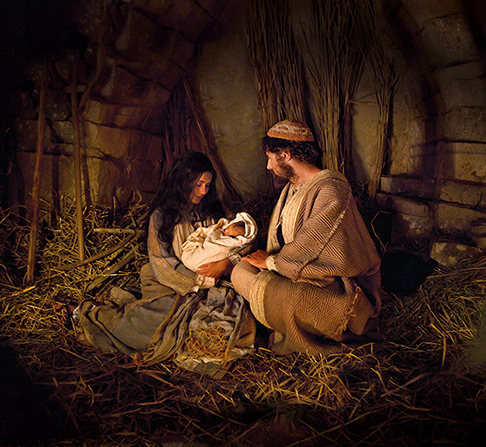
The Lamb being slain from the foundation of the world means that the crucifixion of Jesus Christ was planned from before the world was and Enoch was privileged to see that it would, indeed, happen. He had hope for peace and the joy we will feel for eternity because of God's loving plan and our Savior's love and determination to endure through His essential offering as part of that plan. We are in the season to remember the birth that occurred long ago in the past, rather than from the view from before that Enoch had of it. We have witnesses in scripture and through the Holy Ghost that can give us comfort. But we must each CHOOSE to be comforted. We need to trust, believe, and accept that great Gift. I wish all a very Merry, peaceful, sweet Christmas.
And Jacob rent his clothes, and put sackcloth upon his loins, and mourned for his son many days. All his sons and all his daughters rose up to comfort him; but he refused to be comforted; and he said, For I will go down into the grave unto my son mourning... Genesis 37:34-35
Thus saith the Lord; A voice was heard in Ramah, lamentation and bitter weeping; Rahel weeping for her children refused to be comforted for her children, because they were not. Jeremiah 31:15
He (Coriantumr) began to repent of the evil which he had done; he began to remember the words which had been spoken by the mouth of all the prophets, and he saw them that that were fulfilled thus far, every whit; and his soul mourned and refused to be comforted. (Ether 15:3)
There are even more instances of the Lord offering comfort. There is certainly much need of comfort in this world due to hatred, war, mistreatment, injustice, illness, injury, and on and on. There is not a human on the face of the Earth who has not experienced pain and sorrow. But that's the way it's supposed to be! Shocking as it is to acknowledge that, it's true. For it must needs be, that there is an opposition in all things. (2 Nephi 2:11) It's easy enough to figure out why that is. How can you understand and feel peace if you have never experienced dissension or hatred? How can you comprehend how glorious joy is if you have no idea what sadness is? How can you measure success and accomplishment if you don't know what it means to fail?
So, in this day of wars and rumors of wars, fires, men's hearts turning cold, famine, pestilence, storms, earthquakes, disease, etc., our only reactions are to either harden our hearts to suffering and become part of the problem OR look for a solution. The only solution is from a higher, more experienced and wise Heavenly Parent. Through His Spirit and the gift of His Son, we can be comforted. How? I would recommend a more complete reading of a conversation between the Lord and Enoch, but I will give some highlights:
As Enoch saw this, he had bitterness of soul, and wept over his brethren, and said unto the heavens: I will refuse to be comforted; but the Lord said unto Enoch: Lift up your heart, and be glad; and look. And it came to pass that Enoch looked; and from Noah, he beheld all the families of the earth; and he cried unto the Lord, saying: When shall the day of the Lord come? When shall the blood of the Righteous be shed, that all they that mourn may be sanctified and have eternal life? (referring to the Savior and His Atonement- this was before His mortal life) And the Lord said: It shall be in the meridian of time, in the days of wickedness and vengeance. And behold, Enoch saw the day of the coming of the Son of Man, even in the flesh; and his soul rejoiced, saying: The Righteous is lifted up, and the Lamb is slain from the foundation of the world; and through faith I am in the bosom of the Father, and behold, Zion is with me. (Moses 7:44-47)
The Lamb being slain from the foundation of the world means that the crucifixion of Jesus Christ was planned from before the world was and Enoch was privileged to see that it would, indeed, happen. He had hope for peace and the joy we will feel for eternity because of God's loving plan and our Savior's love and determination to endure through His essential offering as part of that plan. We are in the season to remember the birth that occurred long ago in the past, rather than from the view from before that Enoch had of it. We have witnesses in scripture and through the Holy Ghost that can give us comfort. But we must each CHOOSE to be comforted. We need to trust, believe, and accept that great Gift. I wish all a very Merry, peaceful, sweet Christmas.
Subscribe to:
Posts (Atom)